 |
Archaeological Solutions |
 |
 |
 |
 |
 |
 |
 |
 |
|
|
Archaeological Solutions |
|
|
|
|
|
|
|
|
|
|
PROJECTS A large open area excavation at South Hornchurch, Essex (London Borough of Havering) revealed an extensive Late Bronze Age settlement on the Thames terrace gravels. This site is particularly significant because of the association of a circular ditched enclosure or ringwork with a contemporary field system, as well as clusters of enclosed and unenclosed circular structures. Two enclosures were formed by rings of pits or large postholes. Deliberately-placed deposits of pottery and unurned human cremations were found, mostly associated with structures and entranceways. Other finds include pottery, burnt flint, spindle whorls, possible loomweights, perforated clay slabs and a clay sword mould.
The
latter had been used to mould a sword about 5cm wide; the mould
was in many fragments and it is not clear how long the sword
would have been. The mould was made of a rough, grassy outer
clay wrapping with a smooth inner clay lining. This would have
come into contact with molten metal when it was poured into the
mould. The entire site at Hornchurch was abandoned at the same
time, and was subsequently sealed by ploughsoil, which probably
represents the final phase of Late Bronze Age activity.
A
series of archaeological investigations at Thorley Lane, Thorley,
Bishops Stortford (Herts) in advance of large housing
development, revealed archaeological remains dating from the
Bronze Age to Romano British periods. This extensive site was
examined using geophysics and sampled with trial trenches and
five areas of archaeological interest were revealed. Initial
investigation of 'Site A' revealed part of a Roman settlement or
farmstead, with field boundary ditches, a metalled trackway,
small-scale industry and two inhumations. Further excavation
revealed a series of late Bronze Age ritual pits and late
pre-Roman Iron Age funerary enclosures preceded this farmstead.
The enclosures contained four cremations and three inhumations,
a ritual pit containing a cow skull, another containing horse
mandibles, and a complete dog burial. Dog burials are relatively
common - they were not eaten, although their pelts were
sometimes removed. Hence, dogs were buried whole, while other
animals were butchered. Disarticulated fragments of dog and cat
bones were also found with Roman domestic refuse. Another site which combined ritual and domestic remains was excavated at Oxford Road, Stone, Aylesbury (Bucks). A late Bronze Age hut gully, a cremation and parts of a field boundary, postholes and pits were revealed. One of these pits contained the remains of two late Bronze Age pottery vessels which had been re-used as cremation urns. Iron Age features included a large ditch, three pits and a gully. Interestingly, Bronze Age and Iron Age remains were spatially distinct and rarely overlapped. Excavations at Downs Barn, Milton Keynes, revealed a system of linear and curvilinear ditches of late Iron Age date, one of which contained substantial quantities of Belgic pottery. Although no evidence for houses was recovered, the ditches appear to represent domestic enclosures. A small structure of carefully laid limestone slabs post-dated the enclosures, and was located close to two areas of burning and a deposit of burnt animal bone - these undated features may be evidence for ritual activity.
An
unusual Iron Age ritual site was found at Hartsdown Technology
College, Margate, (Kent) where excavations revealed a crouched
male inhumation in a shallow grave pit cut into the top of an
Iron Age agricultural enclosure ditch. A 'ritual' pit within the
enclosure contained numerous finds including copper alloy
objects and part of a pot, dated to between the 5th and 4th
centuries BC. The inhumation was unusual in that it lay on its
right hand side, with the head to the south and feet to the
north, and inversion of the traditional position. These features
were part of a busy later prehistoric domestic, economic and
ritual landscape. This is an important site, as few formal and
complete inhumation burials are known to date to this period.
The location of the grave suggested a close association with the
ditch - such enclosures may have had symbolic meanings as
'threshold zones' in addition to practical functions. A series of excavations at Jays Close, Basingstoke revealed a late Iron Age - Roman sub-rectangular enclosure with a number of internal features including gullies, grain storage pits and postholes. No evidence for houses was recovered, and the ditches and pits apparently represent domestic and burial activity. Earlier investigations had revealed occupation dating from the late Neolithic/early Bronze Age to the Roman period, including a late Roman well and the possible remains of possible timber-built structures. Of particular interest were two female burials associated with numerous whole and partial animal carcasses, dated to the late Iron Age period. These burials lay above a cist containing carved antler grave goods such as weaving combs and toggles. The more recent excavations revealed a late Iron Age-Early Roman infant inhumation surrounded by animal bones, close to the entrance of the enclosure.
Another Roman child burial was found during excavations at John
Warner School, Hoddesdon (Herts), which revealed archaeological
remains of the late Bronze Age and Roman periods. The earlier
phase included settlement features, such as a large pit
containing flint-knapping debitage, which may have been located
inside a post-built structure. In the Roman period, a series of
ditches may represent the remains of a field or enclosure
system, while two smaller gullies may represent the remains of
structures. One of these gullies contained the remains of a
young child. Until the early 20th century, Letchworth (Herts) was a small, sparsely populated rural parish. The whole area was transformed by social reformer Ebenezer Howard who created his vision of the garden city in 1903. Little archaeological work was carried out at this time, however, so excavations at High Avenue offered a chance to enhance our limited knowledge. The project was a good example of a multi-disciplinary approach in archaeology. Non intrusive techniques used initially included documentary desk-based assessment, a metal detector survey, and a geophysical (magnetometer) survey. A full excavation was conducted after an initial trial trench evaluation had confirmed the presence of archaeological features. A number of parallel ditches were encountered, overlying a dense concentration of smaller ditches and pits. Most of the features had been backfilled with broken but well-preserved Roman pottery and other debris, including oyster shells, roof tile and iron scrap. The finds suggest that this was once a modest working settlement with a wide range of trade links, which reached its peak during the 4th century AD. Excavations on land which once formed part of St Mary's Convent at The Butts, Brentford, have contributed to the understanding of the extent of Roman Brentford. A single Roman pit was recorded as well as a number of post medieval ditches and pits. Although this single Roman pit may appear to be a fairly unexciting discovery, it is useful as it helps to define the limits of intensive Roman activity. Located close to the Roman London-Silchester Road, the site may have been peripheral to the small Roman settlement at Brentford and was in use during the 2nd century AD. A rural site dating to the Late Iron Age and Romano-British Period was excavated in the course of the construction of the Three Valleys Water Pipeline Northern Link: Barley to Wendens Ambo project, which crossed North Herts, Cambridgeshire and Essex. Another Roman farming settlement was discovered east of Great Chishill and consisted of field strips and structural remains, including a cellared building. Evidence suggested that several kilns had been present on the site, which was abandoned during the 4th century AD. An open area excavation at 97-99 High Street, Braintree (Essex) revealed Roman and medieval features, including the much-truncated remains of a metalled surface, the robbed-out foundations of a flint and chalk wall, and a large medieval rubbish pit. The wall and road dated to the 2nd century AD, and may have been part of the expanding later Roman settlement at Braintree. Excavations at Legion's Way, Stansted Road, Bishop's Stortford, (Herts) revealed part of a major Roman road. The Roman Stane Street road crossed the middle of the site, following and alignment suggested by earlier excavations adjacent to the site. Roman roads were generally constructed within two parallel outer ditches and two side ditches. The roads themselves consisted of an embankment between the two inner side ditches. Local stone was laid above this, and topped with smaller stones or gravel. Today, Roman roads appear as a linear hump or agger in the landscape. At Legion's Way, features of Roman date, including possible roadside ditches and adjacent enclosure ditches, evidence for post and slot-built structures and a scatter of pits were recorded. An isolated human burial cut one of the side ditches parallel to the road - this grave did not contain any dateable evidence, but was probably also of Roman date. Excavations revealed the remains of a wealthy Roman farmstead at Tunbridge Lane, Bottisham (Cambs), including two small out-buildings and a gravelled yard surface, as well as several ditches and pits. Occupation spanned the 2nd to 4th centuries AD, and the main phase of occupation dated to the late Roman period. Analysis of the finds has shown that Roman inhabitants of Bottisham were importing stone from as far away as Dorset, and enjoyed foods such as oysters.
Excavations at Buncefield Lane, Hemel Hempstead (Herts),
revealed part of a late Bronze Age agricultural settlement
comprising several fence lines and enclosure ditches. Roman
field ditches, dated to the 1st - 2nd century AD, appear to be a
continuation of a rectangular field system discovered in a
previous excavation, and associated with the nearby 2nd century
Romano-Celtic Wood Lane End temple/villa complex. A series of
excavations carried out on the site of the former Witchford
Aerodrome at the present Lancaster Way Business Park, Ely (Cambs)
revealed substantial evidence for Roman activity, including a
3rd-4th century enclosure ditch. This rural landscape was
re-worked over a period of less than a century. The pottery
assemblage from the site was mainly locally produced Horningsea
ware and some imported Samian ware, as well as a sherd from a
southern Spanish olive oil jar. Finds from the ditches include
numerous coins, glass and a glass bead, a possible loomweight,
building materials such as tile and daub, and a bone pin and
metal items, which suggest high status domestic occupation close
to the site. Two excavations of late Roman inhumation cemeteries have encountered particularly interesting elements of Roman burial ritual, including the practice of dismembering bodies - excavations revealed beheaded skeletons, with the head placed at the feet or between the legs. The purpose of this rite is not clear, but it is a reminder that, although many aspects of the past may seem familiar, some practices are utterly alien to current ways of thinking.
Welwyn Hall is located close to the centre of Old Welwyn
(Herts), adjacent to a known Roman cremation cemetery and the
Roman road from Wheathamsted to Braughing. The site had been
subjected to a number of archaeological interventions prior to
AS's excavations. These had revealed a Roman mausoleum, several
inhumations, and some possible Saxo Norman features. Excavations
revealed the apse, cella, ambulatory and square shrine niche of
the 2nd century mausoleum, as well as part of an enclosed 4th
century inhumation cemetery. Four individuals had been
decapitated and had their heads placed on or between their feet.
AS
excavations have also encountered remains from the late Roman /
post-Roman transition period. Archaeological remains of this
period are often not yet understood, though they are significant
as they may have the potential to answer questions about how
local and incoming populations adapted to the collapse of Roman
authority and why and where new powers emerged. Excavations at
The Star and Fleece, High Street, Kelvedon (Essex), revealed
evidence for several periods of activity including residual
prehistoric flint work, a late Iron Age ditch, an early Roman
track, a gravel quarry pit and boundary ditches, and 1st to 2nd
century AD dumping of domestic and industrial waste. A 2nd
century pit, possibly a grave, contained fragments of human
bone. During the 2nd century, the site was levelled and sand and
gravel were dumped to form hard surfaces. Roman Kelvedon was
abandoned in the 3rd - 4th century. This is reflected in a soil
deposit which built up over these earlier features. Post-Roman
and medieval activity was indicated only by the occurrence of
sparse sherds of pottery.
Excavations north east of Hinxton (Cambs) revealed Romano
British and Saxon features. Previous archaeological work
adjacent to this site revealed two Roman settlement areas,
dating to the 1st-2nd century AD, as well as a ring ditch and a
Roman agricultural ditch systems dated to the 1st to mid 3rd
centuries AD and two 5th-7th century Anglo Saxon sunken featured
buildings. The Roman ditch systems found during these
excavations dated to as late as the 4th century AD. These
represented droveways, paddocks, and field sub-divisions, and
the scarcity of finds suggests that the site lies away from any
centre of occupation. These ditches remained open and were
maintained in the post-Roman period, as upper fills contain
sparse Saxon material, suggesting that elements of the Roman
agricultural landscape may have continued to be used in the
Saxon period. Three further Anglo Saxon sunken featured
buildings were found in the course of this excavation,
indicating the low-intensity settlement of the river valley. The location of the site, near the wealthy Roman settlement of Durobrivae (Water Newton) and the major Roman road known as Ermine Street, is intriguing and suggests a close connection between the new settlers and their Romano-British predecessors. Right: Inhumation of a wealthy woman, showing position of brooch
The majority of the excavated archaeology was of early to middle Saxon date at Cardinal West Distribution Park, Godmanchester. Ceramic evidence suggests that the site was occupied from the 5th to 9th centuries AD, with most pottery dating to the 5th to 7th centuries. This Saxon hamlet had six Grubenhaüser (sunken featured buildings), set within enclosures and associated with three rectangular structures, four pens and a four-post structure as well as several pits and isolated postholes. Artifacts related to woolen textile manufacturing, such as loom-weights, bone needles, pins and a comb were found, as well as numerous sheep bones. A pair of re-used Roman scales and recycled Roman building materials, possibly robbed from the ruins of the nearby Roman town of Godmanchester, were also found.
Excavations at The Priory, St Ives (Cambs), revealed evidence of
Romano British occupation in the form of large, well-maintained
agricultural enclosure ditches and other ditches and pits which
contained domestic refuse. Structural evidence in the form of
clusters of postholes and a fence line suggests a low status
farmstead outside the enclosure, probably in used between the
1st and 4th centuries AD. Saxon pottery dated to the 7th century
and a polished bone pin beater were found within a Grubenhaus.
Other structures may have been present on the site, and were
represented by a series of stake and postholes, and fragments of
furnace lining and slag were found, suggesting that a middle
Saxon industrial iron smelting site was located in the vicinity.
No early medieval features were revealed, but a substantial 13th
to 14th century ditch traversed the site, and may have been the
western boundary of the Priory precinct. Medieval sites Although residual medieval material is frequently encountered in excavations, AS has investigated a number of particularly complete and interesting medieval sites. The following projects range from excavating and analysing entire cemeteries to recording the fabric of ecclesiastical, manorial and farm buildings, and from urban tenement yards to rural drove roads. Archaeology allows a detailed view of everyday life in the medieval period that is not always available in documentary sources.
An
urban excavation, at Kingsgate, Berkhamsted (Herts), provided
copious environmental data. The site was set back from the High
Street frontage and contained medieval tenement strips dating to
the late 12th to 14th century, allowing the comparison between
the rear of the plots where economic and environmental evidence
was concentrated. Walls and ditches demarcated individual
tenement strips. Household items were represented by a complete
key and a fragment of a lock. Foundation stabilising work at
Dean's Yard, Westminster School, close to Westminster Abbey,
offered us the chance to examine part of a World Heritage Site
in the core of London. Excavations revealed the remains of
medieval structures, as well as part of a donkey skeleton,
buried under deep silt below 12th century land reclamation
layers. Finds of donkeys are exceptionally rare on British sites
of all periods, particularly the medieval period. Radiocarbon
dating enhanced the significance of the find, confirming 8th -
9th century AD date - pre-dating the foundation of the Abbey.
This makes it the first confirmed Anglo Saxon donkey in London.
The
changing uses of land can be revealed by archaeological
investigation. Land at Fardells Lane, Elsworth (Cambs) proved to
contain a series of medieval field ditches. Excavations revealed
several distinct phases of Saxo-Norman (10th - 12th century) and
later medieval agricultural activity, possibly including two
post-built structures in fenced tofts, followed by a stock
enclosure, a droveway and an open field. The site lay close to
the historic core of the village, which evolved as a manorial
demesne during the late Anglo-Saxon and early medieval periods.
These boundary shifts may have been linked to local changes in
manorial tenure, village development and farming practices, and
reflect wider changes in medieval society and economy. A later medieval cemetery was investigated at Haverhill (Suffolk), where excavation confirmed the presence of part of a substantial medieval churchyard associated with the earliest parish church. This church was almost certainly of Norman or earlier date, becoming redundant in the 16th century and demolished soon after. Some 355 individual graves were excavated, and there was evidence of some coffins, 'pillow stones' and dress fittings, allowing the cemetery to be dated to the 11th to 14th centuries. Churchyard boundary ditches were also identified. Analysis of the skeletal remains showed a population that often lived as long as 45 years before death. Individuals were affected by a number of 'modern' diseases and ailments, including osteoarthritis, osteoporosis, osteomyelitis, fractures, dental caries and abscesses, possible iron-deficiency anemia and a possible case of tuberculosis.
Later
medieval and post medieval sites can reveal interesting
snapshots of daily life. Excavations at the former Eagle & Child
public house in Whitwell (Herts) revealed post medieval and
modern features, including a large rubbish pit, which contained
18th century finds relating to the early tavern. These comprised
pottery, building materials, clay pipes and bottle glass. 233
clay pipe fragments were found, mostly dating from 1730-1780.
The glass (from over 92 vessels) all came from green bottles.
One bottle stamp was present, and read 'William ... Lill ...
London … 1714'. An iron meat skewer was found, in addition to
butchered cattle bones representing large joints and many oyster
shells. Part of an iron shoe patten, worn to raise shoes from
filthy streets, was also found.
Several building survey and excavation projects have been
undertaken at Grade I listed Ware Priory (Herts) prior to the
renovation of the buildings and the landscaping of the grounds.
This Franciscan Friary dates to the 14th century, and was
occupied by a number of notable families after the dissolution
of the monasteries. The Priory was restored in 1849 by the
architect George Godwin. Archaeological recording of exposed
walls, blocked doors and underfloor masonry has elucidated the
evolution of the building. Trenches encountered a medieval
demolition layer derived from the partial demolition of the
medieval friary as well as robbed-out wall foundations, possibly
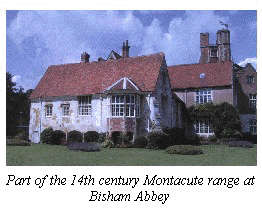
related to the medieval friary church. A prestigious project was undertaken at the National Sports Centre, Bisham Abbey, near Maidenhead in Berkshire. Although the complex is now at the centre of national sporting life, the buildings are significant. The site began as a preceptory of the Knights Templar, and was later re-founded as an Augustinian Abbey. Unusually, a domestic manor house was also attached, which was frequently visited by royalty. Although the monastic buildings have almost entirely disappeared, the buildings retain much of their late 13th century structure. A much smaller building recording project was undertaken on more a more recent religious building at Bishops Stortford Baptist Church, before it was sold and converted into a shop and flats. This church was constructed in 1899 on an earlier site. The simple building has been much renovated and includes some interesting decorative ironwork . Building recording work has also been undertaken at the Old Nursery, Chenies Manor (Bucks), a Grade I listed house near Amersham. The earliest surviving elements of the main building date to the 15th century. Examination of the Old Nursery suggests that it was originally constructed in 1526 as a detached pavilion, banqueting house or lodging, set away from the main house. The antiquarian John Leland visited Chenies on several occasions during the 16th century, and noted that 'fair lodgings be new erected in the garden'. It seems likely that he was referring to this building, later converted into a nursery. AS's survey was conducted before its conversion into a visitor centre. Rural farm buildings are also recorded - a group of agricultural buildings, barns, store houses and stables attached to Thorley Wash Grange were recorded before conversion. AS work revealed an extremely fine set of buildings built shortly after 1800. Among the fine features, a large number of Baltic merchant's marks had survived the carpentry and sawing process. These marks, scribed into the bare timber, were used by merchants at shipping ports along the north German coast for identification and despatch to England. They are poorly understood, but give a fascinating insight into the long distance trade and transportation of timber stocks to a rapacious English market in the 19th century. Much of this pine may have originated in the great forests of Russia and travelled over 2000km before ending up in English agricultural buildings. Cuckman's Farm Barn, near St Albans, was the sole survivor of group of 16th century timber framed buildings. This rare barn had five bays, and may once have formed part of a small domestic building with a central open hall divided by two storeyed solar bays at either end. The building was refurbished in the 19th century and converted to a cattle shed in the 1950s. The former Oxford Road watermill at Aylesbury was excavated and recorded in advance of residential development. The site has near continuous documentary evidence for activity since the Norman Conquest. The Domesday survey listed a mill here, and legal documents provided information about owners, lessees, rent, repairs and development of the mill from the 14th century to 1993, when the mill suffered a serious fire and was demolished. Excavations revealed a 14th century mill channel, and the earliest elements of the mill buildings recorded were of 17th century date. The excavations revealed a complex sequence of modifications, refurbishment and rebuilding of the mill from the 17th century to the 1920s after which time the building was no longer used as a mill. Another building investigated in Ware was the Star Brewery. This was constructed in 1862 by Caleb Hitch, whose father invented the interlocking brick. The brewery was not very successful and had several owners - it was closed down in 1951. The building is an increasingly rare tower-type brewery, which was once common in the region. The brewery has interesting internal features including a cast iron frame and steel pulley wheel which was used to hoist sacks of malt to the top of the brewery. AS has conducted extensive building recording and observation of groundworks at the internationally important site of the old Royal Gunpowder Factory at Waltham Abbey, Essex. The site comprises 200 acres which contain the whole and partial remains of almost 400 buildings which attest to Britain's long involvement in the arms industry. Many unique structures related to the manufacture of gunpowder and later explosives have survived due to the protection afforded by government secrecy. The area has now been preserved as a heritage park. Among the buildings recorded were several gunpowder incorporating mills, magazines, refining houses and press-houses. These industrial structures, many of which date from a massive building programme of the 1870s, were specially designed for the hazards of explosives manufacture, with immense blast walls and flimsy roofs constructed of modern materials. Gunpowder production began here in a private factory in the 17th century, which was taken over by the state in 1787, just before the outbreak of the revolutionary and Napoleonic wars with France. Several buildings of this period survive, and have been the subject of careful and on-going renovation and restoration. The Royal Gunpowder Factory buildings, from 18th century sulphur refining houses to 1960s laboratories, preserve a unique cross-section of an important industry. |
| Tel: 01992 558170 - Fax: 01992 553359 - E-Mail: info@ascontracts.co.uk |
Site best viewed
at 1024x768 with Internet Explorer 5 or later.
All text and images © Archaeological Solutions Ltd
Name & Registered Office:
Archaeological Solutions Limited, 98-100 Fore Street, Hertford, Hertfordshire
SG14 1AB
Company No. 04702122 Registered in England
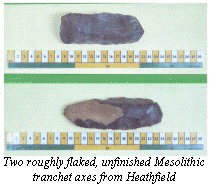
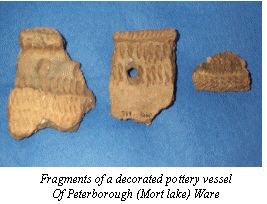 largely of late Bronze Age or early Iron Age date. Traces of
earlier, late Neolithic activity were also found. The natural
geology was sand, and soils in the area have historically been
extremely volatile and an adjacent village was buried by a
violent sand-blow in 1663. In the 20th century, large conifer
plantations have stabilised the soils, but in prehistory,
ditches and other features would have had to be frequently
cleaned out and re-cut. This picture is confirmed by the
numerous phases of enclosure represented on the site. Neolithic
remains included part of a fine, decorated pottery vessel of
Peterborough (Mortlake) ware (see picture) and evidence for
flint-knapping. The more substantial features dated to the late
Bronze Age to early Iron Age, and included several field
enclosure ditches and droveways and post-built roundhouses
situated in the corners of the enclosures. Two unurned
cremations were also found. Peat deposits from an adjacent
palaeochannel of the Little Ouse allowed us to reconstruct the
local environment and vegetation.
largely of late Bronze Age or early Iron Age date. Traces of
earlier, late Neolithic activity were also found. The natural
geology was sand, and soils in the area have historically been
extremely volatile and an adjacent village was buried by a
violent sand-blow in 1663. In the 20th century, large conifer
plantations have stabilised the soils, but in prehistory,
ditches and other features would have had to be frequently
cleaned out and re-cut. This picture is confirmed by the
numerous phases of enclosure represented on the site. Neolithic
remains included part of a fine, decorated pottery vessel of
Peterborough (Mortlake) ware (see picture) and evidence for
flint-knapping. The more substantial features dated to the late
Bronze Age to early Iron Age, and included several field
enclosure ditches and droveways and post-built roundhouses
situated in the corners of the enclosures. Two unurned
cremations were also found. Peat deposits from an adjacent
palaeochannel of the Little Ouse allowed us to reconstruct the
local environment and vegetation.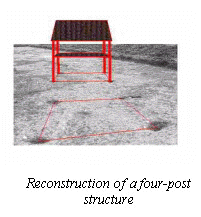
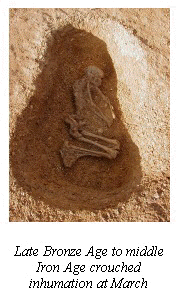 Excavations
at the March Northern Offices Site, March, (Cambs) also revealed
part of a prehistoric agricultural landscape with ritual
elements. Archaeological work revealed features which represent
the remains of agricultural enclosures and a possible droveway,
principally dated to the late Bronze Age to middle Iron Age
period. In addition to these agricultural features, a
contemporary intact crouched burial of a woman aged about 45 was
found (see picture). Discoveries of prehistoric burials in
'border' areas of field boundaries and roads are not unusual, as
sacred and secular activities were combined in a dynamic
landscape.
Excavations
at the March Northern Offices Site, March, (Cambs) also revealed
part of a prehistoric agricultural landscape with ritual
elements. Archaeological work revealed features which represent
the remains of agricultural enclosures and a possible droveway,
principally dated to the late Bronze Age to middle Iron Age
period. In addition to these agricultural features, a
contemporary intact crouched burial of a woman aged about 45 was
found (see picture). Discoveries of prehistoric burials in
'border' areas of field boundaries and roads are not unusual, as
sacred and secular activities were combined in a dynamic
landscape.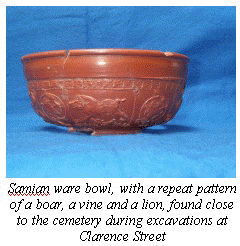
 Excavations
on land at Friary Fields, Dunstable (Beds) revealed the remains
of a late Roman cemetery
Excavations
on land at Friary Fields, Dunstable (Beds) revealed the remains
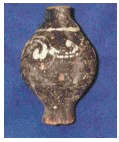
of a late Roman cemetery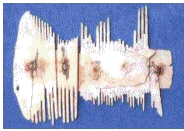 comprising 15 inhumations, including four decapitated burials.
The Romano British cemetery had previously been excavated
between 1968 and 1980, revealing over 100 individuals and
spanning the 3rd to 5th centuries AD. A rare Roman vessel,
possibly a perfume or incense jar, was found in one of the
ditches (see picture to left) and a comb was found close to the
head of one burial (see picture to right).
comprising 15 inhumations, including four decapitated burials.
The Romano British cemetery had previously been excavated
between 1968 and 1980, revealing over 100 individuals and
spanning the 3rd to 5th centuries AD. A rare Roman vessel,
possibly a perfume or incense jar, was found in one of the
ditches (see picture to left) and a comb was found close to the
head of one burial (see picture to right).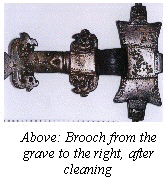 An
early cemetery was excavated at Minerva Business Park, Alwalton,
Peterborough (Cambs). It bel
An
early cemetery was excavated at Minerva Business Park, Alwalton,
Peterborough (Cambs). It bel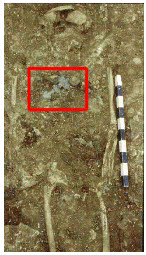 onged
to an Anglian community that lived near Peterborough. This
5th/6th century AD site produced 60 pagan burials, including
contemporary urned cremations and inhumations.
onged
to an Anglian community that lived near Peterborough. This
5th/6th century AD site produced 60 pagan burials, including
contemporary urned cremations and inhumations.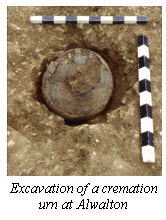 Finds
from this site are sophisticated. The cremation vessels (left),
with their stamped and embossed designs, often contained bone
combs, metal tweezers and other items. The Anglo-Saxons sent
their dead to the underworld adorned with fine clothing and
jewellery (see illustrations above), so that the status and
wealth they enjoyed in life could be taken with them. One female
burial at the site (above) was richly decorated with bronze
brooches and clasps, a necklace of amber and glass beads, and a
pouch hoop of elephant ivory. Enough survived of the skull to
enable a facial reconstruction to be made, which was revealed on
Meet the Ancestors. The woman is said to have had 'very striking
features'.
Finds
from this site are sophisticated. The cremation vessels (left),
with their stamped and embossed designs, often contained bone
combs, metal tweezers and other items. The Anglo-Saxons sent
their dead to the underworld adorned with fine clothing and
jewellery (see illustrations above), so that the status and
wealth they enjoyed in life could be taken with them. One female
burial at the site (above) was richly decorated with bronze
brooches and clasps, a necklace of amber and glass beads, and a
pouch hoop of elephant ivory. Enough survived of the skull to
enable a facial reconstruction to be made, which was revealed on
Meet the Ancestors. The woman is said to have had 'very striking
features'.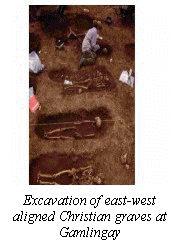 Another
Saxon industrial site was found during excavations at Station
Road, Gamlingay (Cambs), which revealed an Anglo Saxon
farmstead, consisting of a settlement centered around a cluster
of Grubenhaüser and surrounded by enclosures, inhabited from the
late 5th or early 6th century AD. One building contained a large
number of annular loomweights representing either a collapsed
loom or fallen stacked weights. Worked antler, lead weights, pin
beaters, fragments of quernstone, iron slag and copper alloy
slag and hearths were found, suggesting that different types of
craft working were located in different buildings. Such early
Saxon industrial sites are rare, and industry was probably
undertaken on a small scale in order to satisfy local needs. The
settlement may have been abandoned during the middle Saxon
period. A later, Christian inhumation cemetery containing 119
graves was placed away from the area of settlement (see picture
to left).
Another
Saxon industrial site was found during excavations at Station
Road, Gamlingay (Cambs), which revealed an Anglo Saxon
farmstead, consisting of a settlement centered around a cluster
of Grubenhaüser and surrounded by enclosures, inhabited from the
late 5th or early 6th century AD. One building contained a large
number of annular loomweights representing either a collapsed
loom or fallen stacked weights. Worked antler, lead weights, pin
beaters, fragments of quernstone, iron slag and copper alloy
slag and hearths were found, suggesting that different types of
craft working were located in different buildings. Such early
Saxon industrial sites are rare, and industry was probably
undertaken on a small scale in order to satisfy local needs. The
settlement may have been abandoned during the middle Saxon
period. A later, Christian inhumation cemetery containing 119
graves was placed away from the area of settlement (see picture
to left).